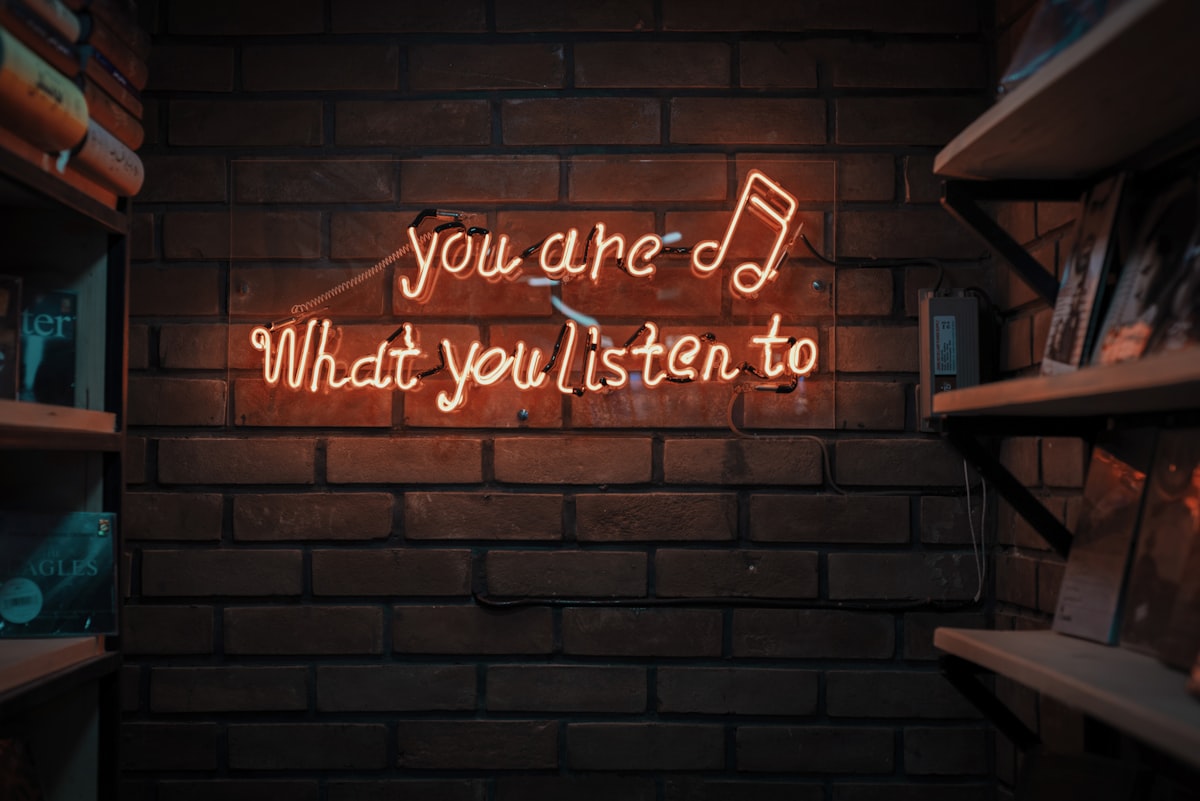
A man walked into a clothing store recently to buy shirts. He mentioned to the associate that his wife had just passed away. While they were talking, the speakers were playing a song whose chorus repeats six times across eight minutes about dying.
Nobody chose that song to play at that moment. It was on a playlist. It came up in rotation. A curator or an algorithm matched the genre and the era. Neither of them read the words. And for eight minutes, a man buying shirts after his wife’s death stood in a room where the speakers were singing about dying.
That is not a hypothetical. It happened. And it is happening in some version, in some store, right now, because nobody is reading the lyrics.
Have you actually read the lyrics on your store speakers? #
Filtering for explicit language is the easy problem. Every playlist service does it. The harder problem is songs that sound pleasant and say something the store would never put on a wall. Production that communicates ease. Lyrics that communicate harm.
The customer does not need to sit and parse the words for them to register. Decades of research on how the brain picks up language without conscious attention tells us that lyrics enter whether the listener is attending to them or not. The words land regardless.
A song about a school shooting, delivered in a whistling indie pop arrangement, appeared in children’s movie trailers before anyone publicly acknowledged what it was about. That song is on retail playlists in stores where parents shop with their kids. Songs about stalking, intimate partner violence, or assault pass as atmosphere because the production is cheerful enough that nobody checks.
The cognitive dissonance #
Violence is the sharpest example. The broader problem is incongruence. When the production sounds relaxed and the lyrics describe something grim, the customer is hearing two signals at once that do not match. They cannot name what feels off. They just feel like the store was slightly off.
Most of the time they leave a little sooner. Some of the time they do not come back.
This extends past violence. Songs written for film soundtracks about explicit adult themes appear on “luxury” and “boutique” playlists because the orchestral production sounds premium. Songs that explicitly mock aspirational consumption play in premium retail because the production is cool and understated. Nobody read the words.
The production says relax. The lyrics say otherwise. The customer does not have to hear them consciously for the mismatch to register.
Why this keeps happening #
Every one of these songs landed on a retail playlist because an algorithm or a curator matched the genre, the tempo, and the energy. Nobody read the lyrics. Nobody asked what images the words would put in a customer’s head while they are holding a product they are deciding whether to buy. Nobody asked whether a woman in the store has a reason to flinch at a song about being watched.
This is what happens when stores source music from catalogs of songs that were written for reasons that have nothing to do with retail. Those songs are legitimate artistic expressions. They have no business playing in your fitting rooms.
What you can do this week #
Walk one of your stores and pay attention to the lyrics for ten minutes. Write down what the songs are actually about. If a human reading your store’s song titles and lyrics for an hour would flag three of them as incongruent with the room, that is the real state of your audio right now.
Then ask your music provider how they screen lyrical content. If the answer is a version of “we filter for explicit language,” you have your answer. They are not reading the words either.
For the retail leader view of why this matters, see the retail leaders page.